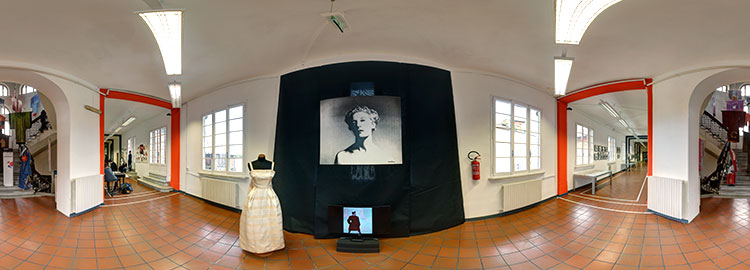
Irene Brin was a pioneering woman, a Mitteleuropean writer, and an innovative journalist who was forgotten too soon.
She was born Maria Vittoria Rossi in Rome on July 14, 1911, to Maria Pia Luzzatto—an intellectual, young, vulnerable, of foreign origin and comfortably bourgeois—and Vincenzo Rossi, a mature general of inflexible principles, of Ligurian and rural origin. The family’s itinerant life, constantly following the father’s assignments, along with her mother’s foreign background—born in Vienna into a Jewish family—made her a true citizen of the world, capable of moving with ease and style in any environment.
Her education was highly unusual: with her husband’s agreement, her mother withdrew her from school at the age of fifteen, after completing middle school. From that moment on, she became her daughter’s teacher and primary intellectual reference. The young Mariù, as she was affectionately called, grew up reading a book a day in multiple languages, soon mastering five of them so thoroughly that she later became a translator of English, French, German, and Spanish. Her passion for writing emerged very early.
When she began writing in 1932 for the newspaper Il Lavoro, she specialized in a type of article later called “lifestyle journalism,” but at the time dismissively referred to as “run-over dogs.” She had excellent mentors such as Mario Melloni and Giovanni Ansaldo, but undoubtedly the most influential was Leo Longanesi, who gave her the pseudonym Irene Brin—a short, brilliant, sharp name, like her writing. On April 3, 1937, she married Lieutenant Gaspero del Corso.
While publishing articles in various newspapers on a wide range of topics, she adopted multiple pseudonyms to differentiate her content and outlets: Marlene, Oriane, Adelina, Ortensia, and Contessa Clara Radjanny von Schewitch. Her earliest literary traces date to 1937 with a short, unpublished story, followed by Olga a Belgrado (1941), inspired by her experiences of the Yugoslav war shared with Gaspero.
These were difficult years. Unable to find sufficient space in newspapers for her reporting, she turned to translation and to writing a biography of La Bella Otero. In 1944 she published Usi e costumi, followed in 1945 by Le visite, a collection of eleven short stories about women. During this time, Irene returned to Rome, living in Palazzo Torlonia, while her husband, after the armistice, hid along with about thirty colleagues in the attic. She took on the responsibility of supporting this demanding “family.” She worked in a small shop owned by friends, “La Margherita” on Via Bissolati, which sold a wide range of items—from handmade jewelry created by Irene herself to paintings received as wedding gifts, from drawings by passing artists such as Renzo Vespignani to personal belongings of the shop’s owners. The shop would later become an art gallery.
Gaspero, under the false identity of Ottorino Maggiore, shared this experience with her. From it, just after the war, on November 23, 1946, at 6:00 p.m., and thanks to a small inheritance from her father, their gallery Galleria L’Obelisco was born on Via Sistina, inaugurated with an exhibition by Giorgio Morandi. The first gallery to open in Rome after World War II, it quickly became a hub for intellectuals of the time. Regulars included Luchino Visconti, Pier Paolo Pasolini, Eugenio Scalfari, Ennio Flaiano, Renato Guttuso, and Alberto Savinio. The gallery not only promoted Italian art—neglected during the Fascist era—but also introduced international artists such as Robert Rauschenberg and Alexander Calder to Italy.
Each year, the couple spent long periods abroad, trading works by artists they promoted as representatives of Italian art and seeking international figures to introduce to the Roman public. In 1947, she published in French her first book on Henri de Toulouse-Lautrec, Images de Lautrec, on the occasion of an exhibition organized by L’Obelisco. Although she continued writing for several newspapers—especially Bellezza, with which she collaborated until her final years—the late 1940s were largely devoted to the gallery.
The growing attention surrounding their “creation,” frequent international travel, and extensive contacts with influential figures enabled the couple to act as ambassadors of a new Italy rising from the ruins of war, serving as cultural mediators between global artistic trends and the vibrant postwar Italian scene.
In 1952, her second book on Toulouse-Lautrec was published, and she began her collaboration as Rome editor for Harper's Bazaar, a role she held until 1969. In this capacity, America recognized her as Italy’s most international journalist. A few years later, in 1955, Italy honored her for having first promoted—perhaps even invented—the concept of Made in Italy worldwide, awarding her the title of Knight Officer of the Order of Merit of the Italian Republic.
From the late 1950s through the 1960s, Irene reached the peak of her career: she was among the highest-paid journalists, continued publishing books under various pseudonyms, and assisted Gaspero at the gallery. There, she helped shape a curatorial direction that rejected American Pop Art in favor of enthusiastically promoting Op Art.
Her professional life never slowed, yet her personal life was marked by highs and lows—days of serenity as well as periods of darkness and desolation. Her relationship with her husband remained deeply affectionate, marked by complicity, respect, and mutual esteem. Her existence was divided between the public persona she had created—eccentric, chameleonic, sophisticated, sometimes even snobbish—and her private fragilities.
In 1968, the first signs of the illness that would lead to her death appeared. She underwent several operations but never stopped writing or traveling. In May 1969, despite her weakness, she set off with Gaspero on what would be her final journey: their gallery had lent Feux d’artifice by Giacomo Balla to Strasbourg for an exhibition on Sergei Diaghilev, and Irene was determined not to miss it.
On their return, however, her strength failed. The couple decided to stop at their beloved home in Sasso di Bordighera. There, after a few days of agony, Irene died on May 29, bringing her brief, wandering life to an end in the only place she truly considered home.